***
title: FAQ
description: Common issues and troubleshooting tips for 0x APIs
---------------------------------------------------------------
## CORS Errors
TL;DR CORS errors happen because the 0x API enforces strict security policies. Avoid making API calls directly from the browser to prevent CORS issues and exposing your API keys. Instead, use a backend server, serverless functions, or a full-stack framework.
**Error Message**
You might see an error like this:
```curl
http://localhost:3000 has been blocked by CORS policy: Request header field 0x-version is not allowed by Access-Control-Allow-Headers in preflight response.
```
Explanation
This error occurs because browsers block requests with custom headers (e.g., 0x-version) unless explicitly allowed by the server. Making API calls from a browser is not recommended because it can expose your API keys.
**Recommended Solutions**
-
Use a Backend Server
— Proxy API calls through a backend server and handle API keys securely (e.g.,
axios
in Node.js or
requests
in Python).
-
Serverless Functions
— Use AWS Lambda, Vercel Functions, or Netlify Functions.
-
Full-Stack Framework
— Implement backend logic in Next.js or Remix.
## Troubleshooting
See Handling API issues and error codes for a full list of common 0x issue types and error codes and how to resolve them.
If your 0x quote is reverting, besides the standard revert issues related to ETH transactions, check the following:
-
Has a
[token allowance](/docs/0x-swap-api/additional-topics/how-to-set-your-token-allowances)
been properly set for the user to trade the
sellToken
?
-
Does the user have enough
sellToken
balance to execute the swap?
-
Does the user have enough to pay the gas?
-
Is the slippage tolerance too low?
-
Is the token liquidity too shallow to be swapped?
-
Did the RFQ Quote expire? RFQ quotes are typically valid for ~60s on mainnet. See the RFQ expiry accordion below.
For more details, see FAQ.
RFQ quotes from Market Makers are only valid for a short period (roughly 60s on mainnet).
Two ways to check:
-
Use the Tenderly debugger on the transaction; look for
getOTCOrderInfo
in the trace and inspect
expiryAndNonce
.
-
You may need to reach out to
0x support
to help decode
expiryAndNonce
.
Best practice: refresh quotes about every 30s to prevent RFQ expiry. See Matcha.xyz for an example.
{" "}
Some subset of 0x orders may revert (not fill) while the overall transaction
succeeds. This is expected: due to timing/pricing, some orders may be filled
or expired before a user attempts to fill. The protocol uses fallback orders
to compensate, resulting in a successful transaction even though internal
order reverts occurred.
Passing a taker lets 0x API provide a bespoke quote and catch revert issues:
-
Estimate gas for
taker
to execute the quote.
-
If successful,
gas
in the quote reflects an accurate execution estimate.
-
If not, a gas estimation error hints at execution issues for that
taker
.
TL;DR Pass taker to validate quotes and avoid many revert cases.
{" "}
Verify that the API request is formatted properly. If the issue persists,{" "}
contact support
.
{" "}
The buy token is not authorized for trade due to legal restrictions.
An internal server error occurred.
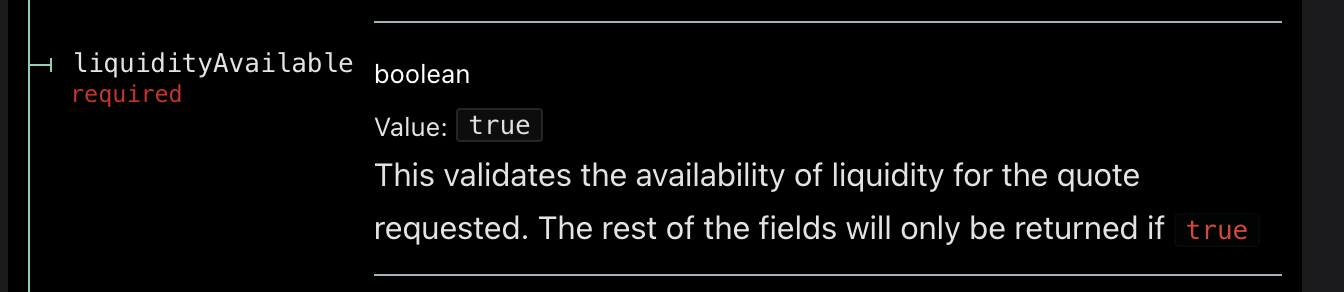
The API will return liquidityAvailable=false and omit other response params if there isn’t enough liquidity available for the requested quote.
 Use the getSources endpoint.
***
## Swap API
### About Swap API
Use the getSources endpoint.
{" "}
Use the getChains{" "}
endpoint to get a list of supported chains for Swap.
We offer two transparent, flexible tiers for Web3 businesses of all sizes. You can get started here. If you are a high-volume app or have a unique business model, please contact us to discuss a custom plan.
0x takes an on-chain fee on swaps for select tokens for teams on the Standard tier. This fee is charged on-chain to your users during the transaction. In cases where we charge a fee, we return the value in the API response as
Use the getSources endpoint.
***
## Swap API
### About Swap API
Use the getSources endpoint.
{" "}
Use the getChains{" "}
endpoint to get a list of supported chains for Swap.
We offer two transparent, flexible tiers for Web3 businesses of all sizes. You can get started here. If you are a high-volume app or have a unique business model, please contact us to discuss a custom plan.
0x takes an on-chain fee on swaps for select tokens for teams on the Standard tier. This fee is charged on-chain to your users during the transaction. In cases where we charge a fee, we return the value in the API response as zeroExFee. See the Swap API reference for details.
Swap API samples each liquidity source and adjusts for gas consumption (using your specified gas price, or a fast default) and any associated fees. It evaluates different compositions of sources to select the best set of orders, and also creates fallback orders to ensure executability.
Example: Curve’s nominal price may look best, but after factoring gas \* gasPrice and fees, it may not be optimal.
{" "}
0x supports all tokens by default except those blocked for compliance reasons.
{" "}
If you’d like to trade a custom token, you’ll need to create liquidity by
deploying a pool on an AMM the API sources (e.g., Uniswap, SushiSwap, Curve).
MEV protection applies to RFQ orders, which are filled privately and atomically to prevent sandwiching/front-running. It does not apply to AMM trades, which execute on public mempools and are subject to typical MEV risks.
### Monetizing your Swap Integration
You can collect affiliate fees or trade surplus. Read the full guide: monetizing your swap integration.
If swapFeeRecipient, swapFeeBps, and swapFeeToken are set, the response includes fees.integratorFee.amount which you can display to users.
```text
amount = (swapFeeBps / 10000) * sellAmount // in sellToken base units
```
Example for 1% of 100 USDC:
-
sellToken=0xA0b8...eB48
(USDC)
-
swapFeeToken=0xA0b8...eB48
-
sellAmount=100000000
(USDC has 6 decimals)
-
swapFeeBps=100
Fee amount = 1000000 = 1 USDC.
See the guide: monetization. In API v2, you can take fees on buyToken or sellToken.
Available to select integrators on a custom pricing plan. Contact support. See the monetization guide.
### AllowanceHolder and Permit2
0x Swap API supports two allowance methods: AllowanceHolder (recommended) and Permit2 (advanced).
AllowanceHolder (Recommended)
Better UX, lower gas, simpler integration, and safe defaults. Great for aggregators, teams upgrading from Swap v1, and advanced wallets (multisigs/smart accounts).
Endpoints:
Allowance target is returned in issues.allowance.spender or allowanceTarget.
Chain-specific AllowanceHolder addresses (verify with official docs before hardcoding):
-
0x0000000000001fF3684f28c67538d4D072C22734
—
**Cancun hardfork chains**
(Ethereum Mainnet, Arbitrum, Avalanche, Base, Berachain, Blast, BSC, Ink, Linea, Mode, Monad, Optimism, Plasma, Polygon, Scroll, Sonic, Unichain, World Chain)
-
0x0000000000005E88410CcDFaDe4a5EfaE4b49562
—
**Shanghai hardfork chains**
(Mantle)
Permit2 (Advanced Only)
Enables time-limited/granular approvals but requires a double-signature flow. If you use Permit2, set allowances on Permit2 only — never on the Settler (funds may be lost).
Endpoints:
Permit2 address (all chains): 0x000000000022D473030F116dDEE9F6B43aC78BA3
Read more about the contracts [here](/docs/core-concepts/contracts).
{" "}
Depends on UX and integration type:
-
AllowanceHolder: single-signature UX, consistent across
sources, similar to Swap v1.
-
Permit2: universal approvals and time-limited/granular
allowances; requires an extra signature.
{" "}
The AllowanceHolder contract.
Ethereum signatures: r, s, v, ordered as r, s, v, where:
-
r < secp256k1n
-
s < (secp256k1n / 2 + 1)
-
v
is 0 or 1; on EVM encode as
27 + v
(27 or 28)
Pack to 65 bytes: bytes 0–31 = r, 32–63 = s, 64 = v.
### Parameter Questions
Gas is the fee required to conduct a transaction on Ethereum, paid in ETH and denominated in Gwei (1 ETH = 1,000,000,000 Gwei).
It’s a standardized representation of native tokens (e.g., ETH, BNB, POL) which don’t have contract addresses like ERC-20s.
On Mantle, \$MNT is an exception. It has the contract address 0xdeaddeaddeaddeaddeaddeaddeaddeaddead0000. Note this is not applicable to wrapped/bridged MNT. See Handling native tokens with 0x Swap API for additional information.
Yes. All buyAmount values are in the token’s base units.
-
18 decimals (e.g., WETH, DAI):
1000000000000000000
\= 1.0
-
6 decimals (e.g., USDC):
1000000
\= 1.0
Useful helpers:
{" "}
No — in v2 only sellAmount is supported for more deterministic
behavior and broader liquidity support.
{" "}
No — taker is required in v2 for /quote. It enables
us to return calldata and identify issues that would cause failures.
The Settler contract can be redeployed; the to target address will therefore change. See: current/future Settler addresses.
### Best Practices
Contact 0x to discuss a solution that best suits your use case.
{" "}
When applicable, the fee is returned as zeroExFee in quotes. You
are responsible for showing the amount and token to
users. See the Pricing Page and{" "}
/quote response
.
{" "}
Not currently, but we’re exploring this feature.
{" "}
Options:
-
Copy from Etherscan (Contract tab → ABI).
-
Use the Etherscan API.
-
Fetch from the token’s GitHub repo if available.
-
Import
erc20Abi from{" "}
viem
.
Depends on your use case:
See the 0x transaction data guide.
Not directly via onchain data alone. While all 0x API trades settle through the Settler contract, transactions don’t include a unique tag that explicitly ties them to the API.
Tracking your own app’s activity:
Detecting any/all API-routed transactions:
-
You can monitor the Settler contract, but it includes non-API transactions.
-
For aggregated usage insights,
reach out
and share your use case.
***
## Gasless API
### About Gasless API
Use the{" "}
getSources{" "}
endpoint.
See the [full list of supported
chains](/docs/core-concepts/0x-cheat-sheet#-chain-support)
**Short answer:**
Gasless API provides a gasless experience at two points of the trade flow where users normally pay gas:
**What doesn’t work:**
You can’t use Gasless API to sell a chain’s native coin (e.g., ETH on Mainnet, POL on Polygon). Native coins aren’t ERC-20s, so they lack transferFrom which the relay system uses. Use the Swap API instead (user pays gas in the native token) or have users wrap the coin (e.g., ETH → WETH).
**Work-arounds for tokens not supported by Gasless API:**
-
Use the regular Swap API — the user pays gas in the native coin.
-
Wrap the coin first (e.g., ETH → WETH), then use Gasless API.
Use the{" "}
Swap API
{" "}
(user pays gas in the native token), or have users wrap the native coin first
(e.g., ETH → WETH), then use Gasless API.
It varies by chain, size, and gas conditions. If the amount is too small, the
API returns an error with the estimated minimum. As a guideline, set a minimum
of about $10 on Mainnet and $1 on other chains.
Both enable gasless-like UX, but they serve different purposes.
In short: Permit (EIP-2612) is an ERC-20 extension
enabling gasless approvals via an EIP-712 signature — no on-chain tx —
but only for tokens that implement EIP-2612. Many older tokens (e.g., WETH) don’t,
so they still need a regular approve().
Permit2 (by Uniswap Labs) is a universal approval contract for
any ERC-20. Users first do a standard gasful approve() to Permit2,
then future moves can be authorized via EIP-712 signatures (gasless for subsequent
swaps). This is useful when tokens don’t support permit() but you
want a consistent meta-tx flow. Permit2 is deployed at
0x000000000022D473030F116dDEE9F6B43aC78BA3 on major chains.
### Gas
0x covers the gas fee up front. The cost is wrapped into the trade and paid in
the token the user is trading. Applications may choose to sponsor
transactions; in that case they pay 0x directly and users are not billed on
chain.
### Monetizing Gasless API
You have full flexibility on the fees you collect on trades.
Include these parameters when making a Gasless API request:
-
swapFeeRecipient
— Wallet address to receive trading fees.
-
swapFeeBps
— Fee in basis points (0–1000; 1000 Bps = 10%).
-
swapFeeToken
— Contract address of the token to receive fees (must be
buyToken
or
sellToken
).
```bash
https://api.0x.org/gasless/quote # Request a firm quote
?chainId=1 # Ethereum Mainnet
&sellToken=0x6B175474E89094C44Da98b954EedeAC495271d0F # Sell DAI
&sellAmount=4000000000000000000000 # Sell amount: 4000 (18 decimals)
&buyToken=0xEeeeeEeeeEeEeeEeEeEeeEEEeeeeEeeeeeeeEEeE # Buy ETH
&taker=$USER_TAKER_ADDRESS # Trader address
&swapFeeRecipient=$INTEGRATOR_WALLET_ADDRESS # Recipient of affiliate fees
&swapFeeBps=100 # 1% fee (100 bps)
&swapFeeToken=0x6B175474E89094C44Da98b954EedeAC495271d0F # Take fee in sellToken (DAI)
--header '0x-api-key: [API_KEY]' # Your API key
--header '0x-version: v2' # API version
```
### Gasless Approvals
Gasless approvals are supported only for tokens listed in the [gasless
approval token
endpoint](https://0x.org/docs/api#tag/Gasless/operation/gasless::getGaslessApprovalTokens).
Check the response from
[/gasless/quote](https://0x.org/docs/api#tag/Gasless/operation/gasless::getQuote),
-
If
issues.allowance is not null, an allowance
approval is required.
-
If
approval is not null, a gasless approval is
possible.
Gasless approvals and gasless swap are bundled in the same{" "}
transaction, but each requires a signature for its EIP-712 object. You can
design the UI so it feels like a single step to the user.
See the flow charts{" "}
here
.
### Troubleshooting
Read more about{" "}
Status Codes
.
***
## Trade Analytics API
The Trade Analytics API gives integrators easy access to the history of trades initiated through 0x APIs and settled on 0x Smart Contracts. This API offers comprehensive transaction records, providing useful insights into user trading behavior.
{" "}
The Trade Analytics API will only return data for the app associated with the
API key that makes the request. While all trading data is publicly available
onchain, the Trade Analytics API provides a streamlined, well formatted data
for the specific app making the request.
The data accessed through the API is deemed final 48 hours after a trade is completed. This delay allows time for the data pipeline to capture all relevant information, including fees from proxy contracts and updated USD prices from Coingecko.
To ensure that your trading data is up to date, we recommend that you fetch and update data from the preceding 2 days in addition to the current day.
Data is updated roughly every 15 minutes. While generally reliable, data from these updates can sometimes be missing or incomplete, especially if they have a dependency on external sources such as token USD price providers. Each trade data is considered final 48 hours after it’s mined onchain – this enables us to address any gaps from earlier updates, ensuring data accuracy.
We don’t recommend using this API for use cases that require real time updates. If you’re interested in such data, please [submit a feature request](https://0x.canny.io/request-features).
It's a common question — and the short answer is: **not directly via onchain data alone.**
While all 0x API trades are settled through the 0x Settler smart contract, these transactions don’t include a unique tag or flag that explicitly ties them to the API.
That said, there are a few ways to approach attribution, depending on what you're trying to track:
**🔍 If you're trying to track your own app's activity**
-
The
0x Trade Analytics API
is the best place to start. It allows you to query detailed trade data associated with your API key.
-
Enable onchain tagging. In your
0x Dashboard
, go to your app’s
Settings
and toggle on
“Enable onchain tagging.”
This makes it easier to filter and trace your transactions onchain later.
**🌍 If you're trying to detect any and all transactions routed via the 0x API**
-
You can monitor the 0x Settler contract for activity, but this includes all transactions — not just those initiated via the 0x API.
-
Currently, there is no canonical event that maps directly to “this came from the Swap API,” but we’re exploring ways to make API attribution more accessible in the future.
-
If you're interested in aggregated Swap API usage data, we may be able to share insights or internal tools depending on your use case.
[Reach out to us](https://0x.org/contact)
— we’d love to hear more about what you're trying to build.
We understand attribution is an important use case, whether you're tracking your own usage or seeking broader ecosystem insights. Don’t hesitate to contact us to discuss how we can best support you.
Trade Analytics API is best for historical analysis and business intelligence. Provides comprehensive trade data including volumes, fees, and USD values.
0x-parser is a best for real-time transaction data and displaying final swap amounts immediately after settlement.
Read more about [accessing 0x transaction data here](/docs/core-concepts/transaction-data).
***
## 0x Dashboard
For now we only support one user per team account, but we will add support for multiple users in the coming weeks.
An app is a self-contained unit for each application that you’re building. You can set up multiple apps, each with unique API keys and configurations, on the 0x Dashboard.
***
## Smart Contracts
Yes. See{" "}
audit reports
. Check out our
bounty program
.
***
## Building with 0x
Create an account on the 0x Dashboard to get an API key and start building for free. You can also review plans and contact our team for custom needs.
Thank you for your interest in providing liquidity to the 0x ecosystem. Please refer to the ["Liquidity Integrations"](/liquidity-integration/liquidity-integrations) tab.